
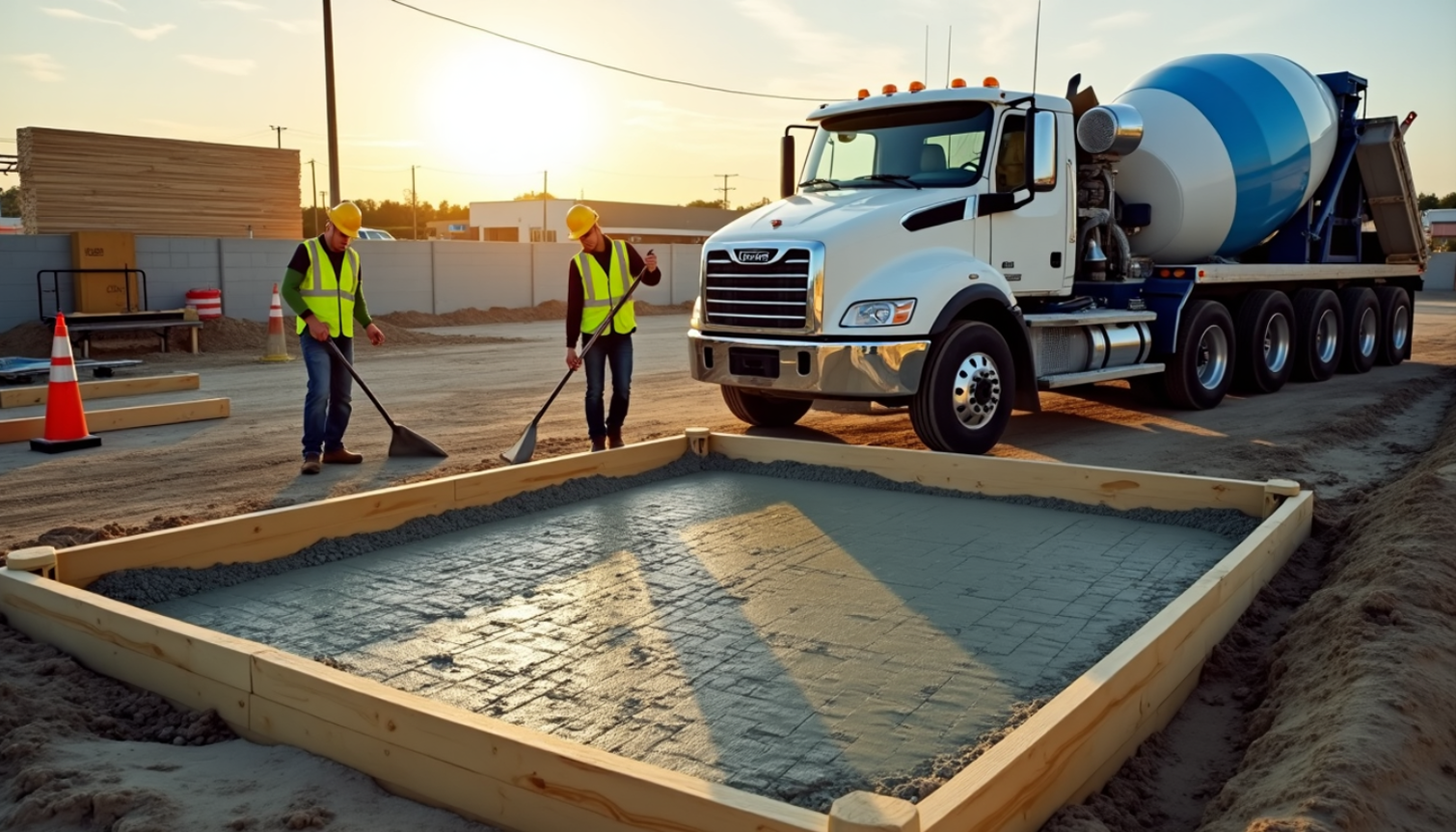
Quick Tips Before We Dive In:
- Get the Right Mix – The dispatchers at the concrete plant can help you choose the right mix for the job. Don’t guess – ask!
- Don’t Underestimate Volume – Running short on concrete is a costly mistake. Always double-check your calculations.
- Make Sure the Truck Fits – These trucks are big – up to 4m high, 3m wide, and weighing around 30 tons. Make sure there’s enough space for access.
- Time is Ticking – Concrete needs to be poured within 1.5 hours of batching, or it can start setting too soon.
- Order a Little Extra – Adding 4-8% more helps cover spillage, uneven surfaces, and minor miscalculations.
- Watch for Extra Fees – Some suppliers charge for long wait times, so be clear on their time limits before ordering.
Fun fact to take into consideration:
“A concrete delivery truck can weigh more than 60,000 lbs (30 short tons). That’s like five adult elephants rolling up to your job site with your ready mixed concrete delivery.”
The real challenge starts when that massive truck arrives at your site. You get just 1.5 hours to complete the pour before (from batching at the plant) the concrete begins to set. First-time concrete ordering can feel overwhelming because too little concrete could stop your project, and too much means wasted money.
Most contractors recommend adding 4% to 10% extra concrete to handle spillage and surface variations. This is just one of many significant details you should know. Your project size doesn’t matter – we’ll guide you through all the essentials of ordering ready mix concrete, from small home projects to larger construction jobs.
The process breaks down into simple, manageable steps that help you dodge mistakes that get pricey and make sure your concrete project runs smoothly from order to delivery.
Understanding Ready Mix Concrete Basics
Ready mix concrete is the life-blood of modern construction. Specialized batch plants manufacture it under controlled conditions. This engineered mixture contains precisely measured ingredients: 10-15% cement, 60-75% aggregates, and 10-15% water, with 3-5% entrained air.
The batch plant combines these key components:
- Portland cement – The binding agent
- Aggregates (sand and gravel) – Providing structure
- Water – Activating the chemical reaction
- Optional additives – Enhancing specific properties
The water-to-cement ratio plays a crucial role in ready mix concrete’s quality. Stronger concrete comes from a lower ratio that balances well with workability. Standard ready-mix concrete is workable for about 90 minutes. Special mixes with retarders can extend workability up to 3-4 hours, but 4-6 hours is not typical for standard concrete.
Ready mix concrete provides many advantages over site mixing. Quality remains consistent across batches thanks to the controlled manufacturing environment. Batching plants use fine-tuned equipment and exact measurements that result in uniform strength and composition throughout projects.
Construction becomes more efficient with ready mix concrete delivery. Contractors reduce labor costs and save storage space for raw materials since the concrete arrives ready to use. It also helps customers order exactly what they need, which reduces material waste.
Ready mix concrete offers great environmental benefits. Dust pollution stays minimal because mixing happens in closed chambers. The industry uses recycled materials like fly ash and ground slag that would otherwise end up in landfills.
Planning Your First Concrete Order
Your concrete project’s success starts with precise planning. The foundation of your order depends on accurate volume calculation. You should multiply the length, width, and depth of your project area and add 5-10% extra to handle potential wastage and surface variations.
Your project’s specific requirements determine the right concrete mix choice. Residential projects typically use these types for different needs:
- Fast-setting concrete – Sets in 20-40 minutes, perfect for fence posts and small slabs
- High-strength concrete – Perfect for foundations and heavy equipment bases
- All-purpose concrete – Works well for sidewalks, steps, and simple repairs
Accurate site measurements play a vital role in project success. The water-cement ratio greatly affects your concrete’s strength, which typically needs 7-15% cement, 60-75% aggregate, and 14-21% water. These precise measurements ensure you get optimal mix proportions and structural integrity.
The batch plant combines these key components:
- Portland cement – The binding agent
- Aggregates (sand and gravel) – Providing structure
- Water – Activating the chemical reaction
- Optional additives – Enhancing specific properties
The water-to-cement ratio plays a crucial role in ready mix concrete’s quality. Stronger concrete comes from a lower ratio that balances well with workability. Standard ready-mix concrete is workable for about 90 minutes. Special mixes with retarders can extend workability up to 3-4 hours, but 4-6 hours is not typical for standard concrete.
You need to coordinate with your supplier to set a realistic timeline. Concrete plants don’t appreciate being told a job will take less time than it actually will, and they can get quite frustrated about it. Depending on the agreement, you might be charged an extra fee if waiting times exceed what was communicated in advance, as this can disrupt their delivery schedule.
Essential Steps for Ordering Concrete
Your project’s success largely depends on choosing the right concrete supplier. Quality suppliers run strict testing protocols and quality checks throughout production. You should assess suppliers based on their production capacity and site proximity.
The supplier’s location plays a crucial role. It is important to understand that for best results, concrete needs pouring within 90 minutes of batching at the plant to work best. Closer suppliers cut transportation costs and reduce delivery delays.
At the time you assess potential suppliers, look for everything in these qualifications:
- Adequate fleet size to deliver on time
- Proven track record with similar projects
- Strong customer service reputation
- They provide the specific concrete mix you require
It is best to place orders at least one week before delivery. Your order must include concrete mix specification. It’s best to consult a specialist or plant personnel to determine the correct specifications for your order.
The mix design needs specific slump requirements – usually 3 to 5 inches for most applications. Air content requirements vary with exposure conditions, typically ranging from 4% to 6% to resist freeze-thaw. The concrete producer must deliver concrete with requested slump and air content, within accepted tolerances, measured where it’s discharged.
Clear communication about your performance requirements matters for both plastic and hardened concrete states. The producer needs detailed information about the predicted exposure and service conditions to supply the right material strength and suggest suitable admixtures.
Site access requirements for concrete trucks
A solid site preparation will give a strong foundation for successful concrete delivery. Planning your delivery setup properly helps prevent delays and keeps everyone safe during the pour.
Preparing for Concrete Delivery
Ready mix concrete trucks need specific site conditions to operate safely. We cleared the access route to be at least 3 meters wide. Your ground should be stable enough to support these massive vehicles because paving slabs and domestic slabs can’t handle their weight. The discharge position needs 6 meters of clear space from all obstructions.
Tools and equipment needed
A detailed set of tools will give a smooth concrete placement. You’ll need these important items:
- Screeds and floats for leveling and smoothing
- Vibrators for removing air pockets
- Wheelbarrows for material transport
Concrete vibrators play a vital role, especially when you have deeper concrete slabs. They operate with a force of 25,000 pounds to prevent collapse. Keep finishing tools like trowels and brushes ready during the pour to achieve the surface texture you want.
Conclusion
Your project’s success relies heavily on good preparation. A well-laid-out site, proper access routes, and the right tools on hand before delivery will make operations run smoothly. Note that timing is a vital factor – concrete stays workable for only 90 minutes after mixing.
New concrete buyers should focus on choosing suppliers and getting mix specifications right. Quality suppliers within an hour’s drive, the right mix design for your needs, and clear communication about performance requirements will help you avoid mistakes that can get pricey.
FAQs
Q1. How much ready mix concrete should I order for my project?
It’s recommended to order 5-10% extra concrete to account for potential wastage and surface variations. Calculate the volume by multiplying the length, width, and depth of your project area, then add this extra percentage to ensure you have enough material.
Q2. What information do I need to provide when ordering ready mix concrete?
When placing an order, provide details such as the concrete mix specifications, nominal maximum aggregate size (typically 3/4 to 1 inch), slump requirements (usually 3 to 5 inches for most applications), and air content requirements (typically 4% to 6% for freeze-thaw resistance). Also, communicate your performance requirements for both plastic and hardened states of concrete.
Q3. How long does ready mix concrete remain workable after mixing?
Ready mix concrete typically remains workable for about 90 minutes after mixing. This timeframe is crucial for planning the delivery and placement of the concrete, as it needs to be poured and finished within this window for optimal results.
Q4. What site preparations are necessary for concrete delivery? Prepare a clear access route at least 3 meters wide for the concrete truck. Ensure the ground is stable enough to support the heavy vehicle. Set up a washout area away from water sources and drainage systems. Have essential tools ready, including screeds, floats, vibrators, and safety gear.
Q5. Is it more cost-effective to buy ready mix concrete or mix it myself?
The cost-effectiveness depends on your project size. For small projects, mixing your own concrete can be cheaper and more convenient. However, for larger projects, ready mix concrete is often more economical and efficient. It ensures consistent quality, saves time and labor, and is delivered ready to use, which can be particularly advantageous for big construction jobs.